Late payment costs the UK economy £11 billion a year and closes 38 businesses a day. Those are the Government's own figures, and they sit at the top of the factsheet for the Commercial Payments Bill, introduced to Parliament in May 2026 after a consultation that drew 867 responses. It is the most significant piece of late-payment law in over 25 years, and recruitment, an industry built on paying people weekly and being paid monthly or later, has more riding on it than most.
None of the recruitment funders' blogs we read this month mention it. That is a gap worth filling, because the bill matters to agencies in ways that are both bigger and smaller than the headline.
What is in the bill
- Maximum payment terms of 60 days, "with strictly limited exemptions".
- Mandatory interest on late payment at 8% above Bank of England base rate. Today that rate exists as a right under the Late Payment of Commercial Debts (Interest) Act 1998, but almost nobody claims it for fear of souring the relationship. The bill turns a right into a requirement.
- A fixed sum for suppliers where a purchaser raises a dispute late or without sufficient information.
- A ban on retention deductions under construction contracts, with timing still to be consulted on.
- New powers for the Small Business Commissioner: to investigate large businesses that persistently pay late, to adjudicate disputes between small and larger businesses outside the courts with binding interim decisions, and to impose financial penalties.
- Tougher reporting for large companies, including the interest they have paid and owe, and a requirement for the boards of persistent late payers to publish an explanation.
There is no commencement date. The Government has promised "an appropriate lead-in time" and a transition period, and has said nothing will apply retrospectively. Realistically, 2027 at the earliest.
What it means for an agency
The 60-day ceiling bites on your largest clients, not your smallest. Most agencies trade with SMEs on 30 days or less. It is the big hirers, the MSPs and the neutral vendors who push 60, 75 and 90-day terms, and it is precisely those clients where the exemptions will be fought over. Read the exemptions when they are published; if managed-service and framework arrangements are carved out, the cap will miss the terms that hurt most.
Mandatory interest changes the conversation with a late payer. Today, asking for statutory interest is a choice, and most agencies choose not to. When the law requires it, the awkwardness disappears: it is no longer you being difficult, it is the rules. That is good for cash and, less obviously, good for relationships, because it takes the personal edge out of chasing.
The disputed-invoice fixed sum is more useful than it looks. A large share of late payment in recruitment is not refusal, it is a timesheet query raised on day 28 of 30-day terms. A fixed sum for disputes raised late or without information gives you a lever against that habit.
The Commissioner is for small versus large. The adjudication and investigation powers are framed around small businesses dealing with larger ones. An agency chasing a slow-paying SME client will still be using the courts or its funder's collections team.
What it does not do
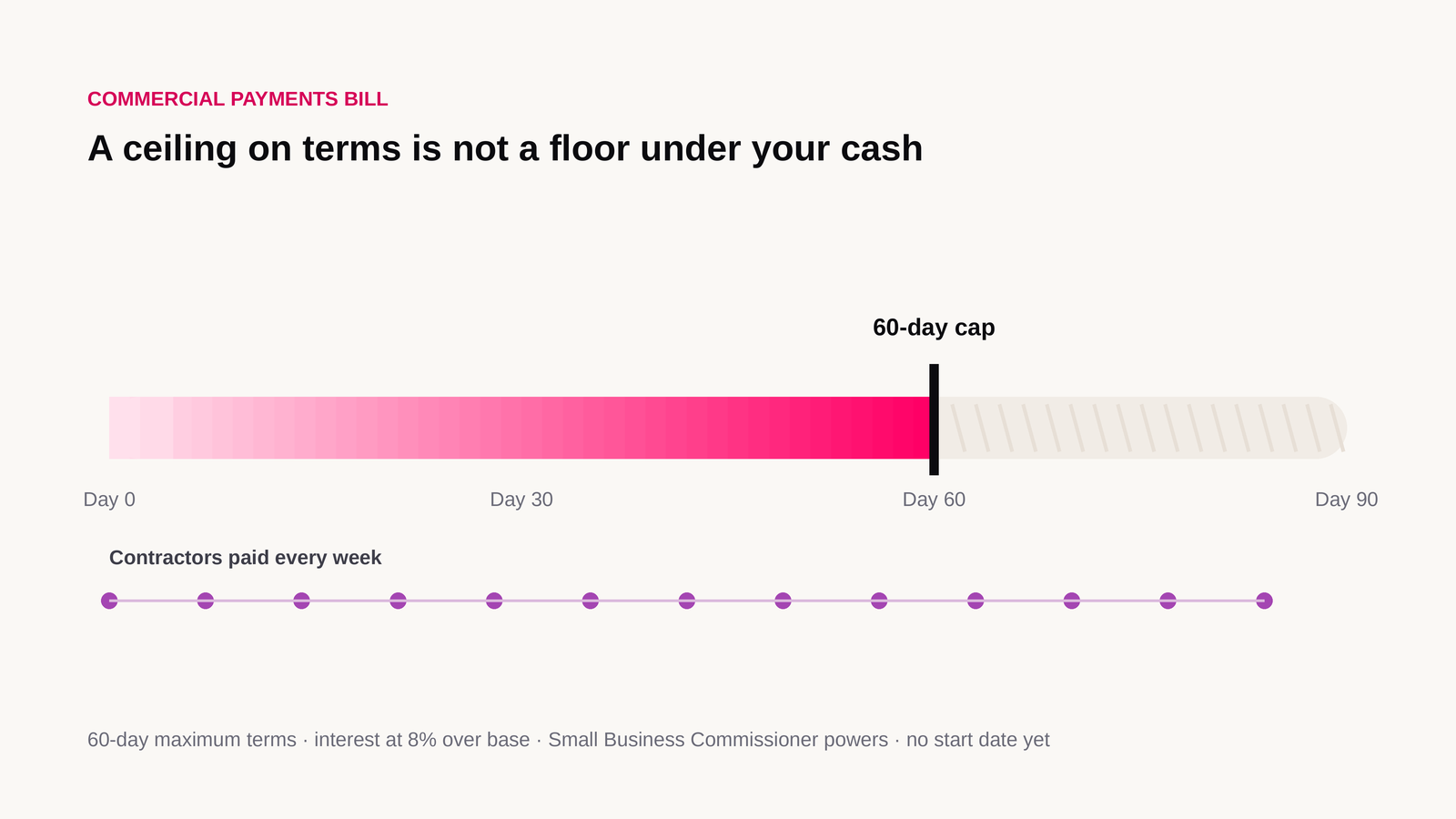
This is where the honest reading matters. The bill caps terms at 60 days. It does not shorten them to seven. Your contractors will still expect paying on Friday and your best client will still, lawfully, pay you on day 60. The gap between the two is the whole reason recruitment finance exists, and a 60-day cap leaves it almost entirely intact. Nor does the bill make anyone pay on time: a client on 30-day terms who pays on day 45 is already breaking the contract, and interest, however mandatory, is collected after the money is late, not instead of it being late.
So the right way to think about the bill is as a modest improvement in the behaviour of your largest clients, arriving in 2027 or later, that does nothing about the weekly cash cycle in the meantime.
What to do now
- List your clients by contractual terms and actual days to pay. The two columns rarely match. The gap between them is the number the bill will help with; the first column is the number your funding has to cover regardless.
- Check your own terms of business for the interest clause. Most templates reference the 1998 Act already. Make sure yours does, and make sure your clients have signed it.
- Watch the exemptions. If you supply into MSPs or public sector frameworks, ask your trade body what it is lobbying for.
- Price your terms honestly. A 60-day client costs more to fund than a 30-day one. Whether that cost sits with you or with your funder, it should be visible in the margin you agree.
Where we come in
At Raise, funding is priced per placement and the price moves with the client's payment terms, so a 30-day client costs you less than a 60-day one and you can see the difference before you sign. Collections are run for you and chased with care, because the client relationship is yours and we treat it that way. And forecasting by client shows you which terms are actually being honoured. If you want to see what a 60-day cap would do to your book, and what it would not, that is a fifteen-minute conversation with real numbers.
General information, not legal advice. The Commercial Payments Bill was before Parliament and subject to amendment when this was written on 28 September 2026.
Sources
- Commercial Payments Bill: overview, Department for Business, Innovation, Science and Trade, published 19 May 2026
- Late payments: tackling poor payment practices, consultation and government response, 24 March 2026
- Late Payment of Commercial Debts (Interest) Act 1998, legislation.gov.uk
- Fair Payment Code, Office of the Small Business Commissioner