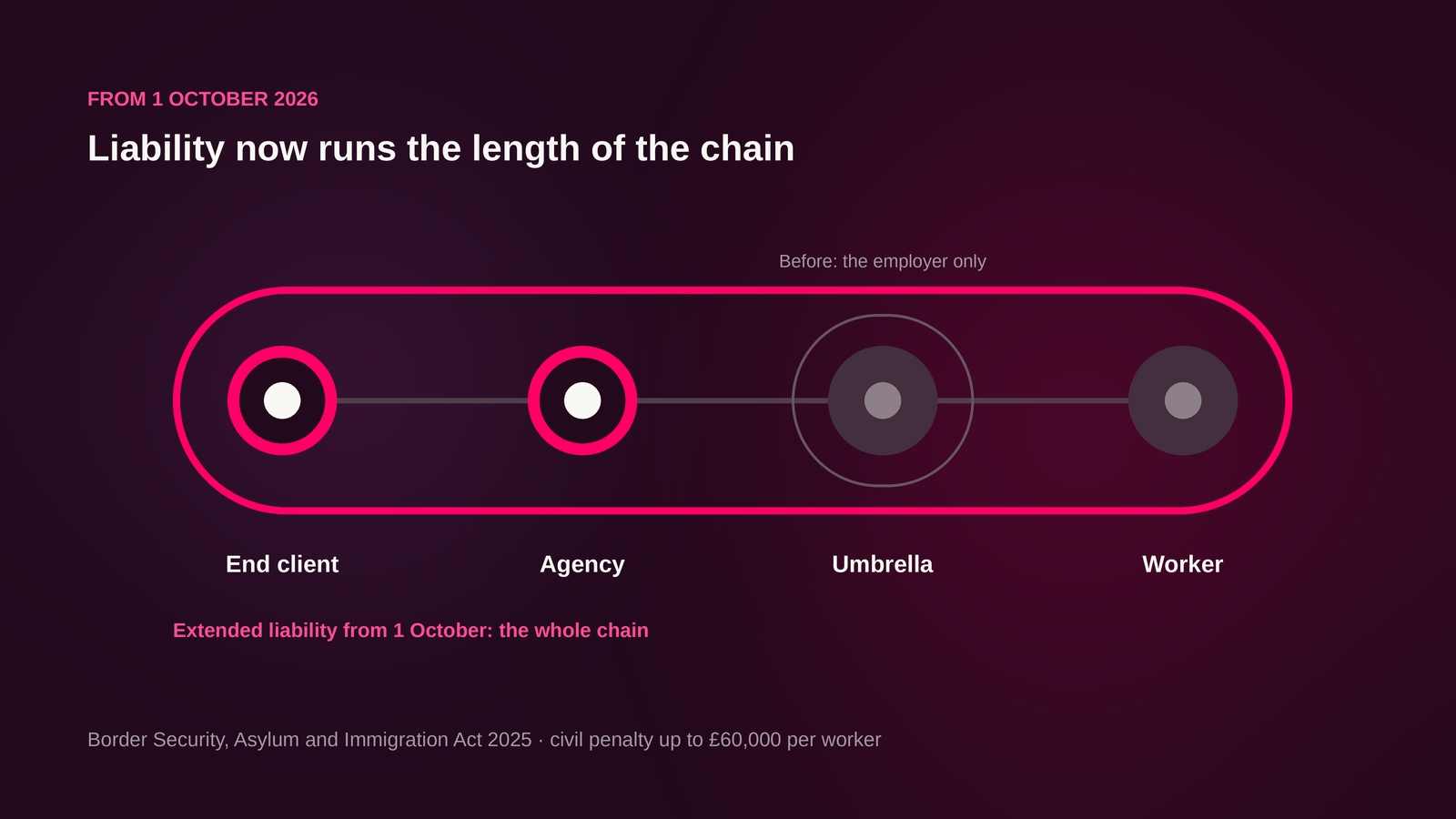
For as long as most agency owners have been in the industry, a right to work check has been something the employer does. If the worker is a temp on your payroll, you do it. If they are through an umbrella, the umbrella does it. If they are a limited company contractor, it is their own affair. That division of labour ends on 1 October 2026.
The change comes from the Border Security, Asylum and Immigration Act 2025, and the Home Office set out how it will work in a draft employer's guide published in July. The short version, from law firm Watson Farley & Williams: "immigration compliance is becoming a supply chain issue as much as an HR issue" (WFW, 5 August 2026). Recruitment and labour supply is named as one of the sectors it will hit hardest.
What actually changes
The method of checking does not change. A share code check, a manual document check where still permitted, a check through an approved digital verification provider, or the Employer Checking Service: all of those stay. What changes is who has to do them and when liability arises.
- A wider definition of employer. The regime now reaches people engaged on a worker's contract rather than a contract of employment, individual subcontractors, workers found through online matching platforms, and arrangements where an individual is allowed to send a substitute.
- Extended liability. A business can face a civil penalty where illegal working happens further down a chain of contracts it sits in, even though it never employed or engaged the worker. The examples given include organisations that provide workers to fulfil contracts with third parties, which is a description of a recruitment agency.
- The same penalties, applied more widely. The civil penalty is up to £60,000 per illegal worker, with criminal sanctions of up to five years' imprisonment and an unlimited fine in the most serious cases (gov.uk). Sponsor licence suspension and public naming by the Home Office sit alongside.
Irwin Mitchell's head of immigration, Mandeep Khroud, put the point that matters bluntly: the Home Office "will focus on the reality of working arrangements rather than the labels used in contracts" (Business Matters, 3 September 2026). Calling someone self-employed does not take them out of scope.
Why this lands on agencies specifically
Think about a typical chain: end client, your agency, an umbrella company, the worker. Under the old rules, the umbrella was the employer, so the umbrella held the statutory excuse and the risk. You did your own check as good practice and because the Conduct Regulations expect it, but the penalty, if things went wrong, was not yours.
From October, the client and the agency can both be caught by extended liability for the same worker. Your client will work that out too, probably after reading a law firm briefing like the ones quoted here, and will push the question down to you in the same way they pushed umbrella due diligence down after April. Expect terms of business to arrive with new right to work clauses in them.
The statutory excuse has three new parts
Where extended liability applies, the draft guidance makes clear that a check on its own is not enough. To hold a statutory excuse you will also need to show:
- Contractual controls. Contracts that allocate responsibility for right to work compliance, require information to be shared, and give you audit rights over the party doing the check.
- Substitution controls. If a contract allows a worker to send someone else, you need a working mechanism to approve and check the substitute. Relying on the clause alone will not do.
- Identity verification. Evidence that the person actually doing the work is the person who was checked. This is aimed squarely at layered supply chains where a document is checked at one end and a different person turns up at the other.
The awkward bit for contract recruiters
Substitution clauses are in almost every limited company contractor agreement in the country, because a genuine right of substitution is one of the pillars of an outside-IR35 position. Nobody expected anyone to use them. From October, that clause creates a duty: if the contract permits substitution, you need a process for it. That does not mean removing the clause, which would have its own IR35 consequences. It means writing down who a substitute is notified to, who checks them, and how, and then keeping the record. Take advice on your own contracts before you change a word.
Four things to sort this week
- Map the chain for every live placement. For each worker: who is the employer or engager, who did the right to work check, on what date, by which method, and where is the evidence? If the honest answer for a block of umbrella workers is "the umbrella says they did", that block is your exposure.
- Put it in the paper. Your umbrella agreements and payroll PSL terms need right to work responsibility, information-sharing and audit rights spelled out. Your client terms need the same, so that responsibility does not silently default to you.
- Decide how you will verify identity. Share codes for those with digital status. An approved digital verification provider for British and Irish passport holders. A dated, named record for every check, kept for the duration of the engagement and two years after.
- Build the substitution process. A one-page procedure is enough: notification, approval, check, record. Then tell your contractors it exists.
Where we come in
Every contractor placed through a Raise-funded agency comes through our onboarding, which is where compliance details are gathered and stored, and the placement, timesheet and payment records live in the same place. We run contractor PAYE ourselves for agencies that want the chain short, and maintain a payroll PSL of vetted employment providers for those that need an umbrella. When a client asks who checked whom, and when, the answer should be a report, not a week of emails. If you want to see what your current book looks like against the new rules, we can walk through it placement by placement.
General information, not legal advice. The employer's guide referred to was in draft when this was written on 28 September 2026. Take advice on your own contracts and arrangements before acting.
-
Sources
- Right to work checks from 1 October 2026: what businesses need to know, Watson Farley & Williams, 5 August 2026
- Firms told to audit labour supply chains as Right to Work checks extend to subcontractors from 1 October, Business Matters, 3 September 2026
- Employer's guide to right to work checks, Home Office
- Penalties for employing illegal workers, gov.uk
- Border Security, Asylum and Immigration Act 2025 (c. 31), legislation.gov.uk