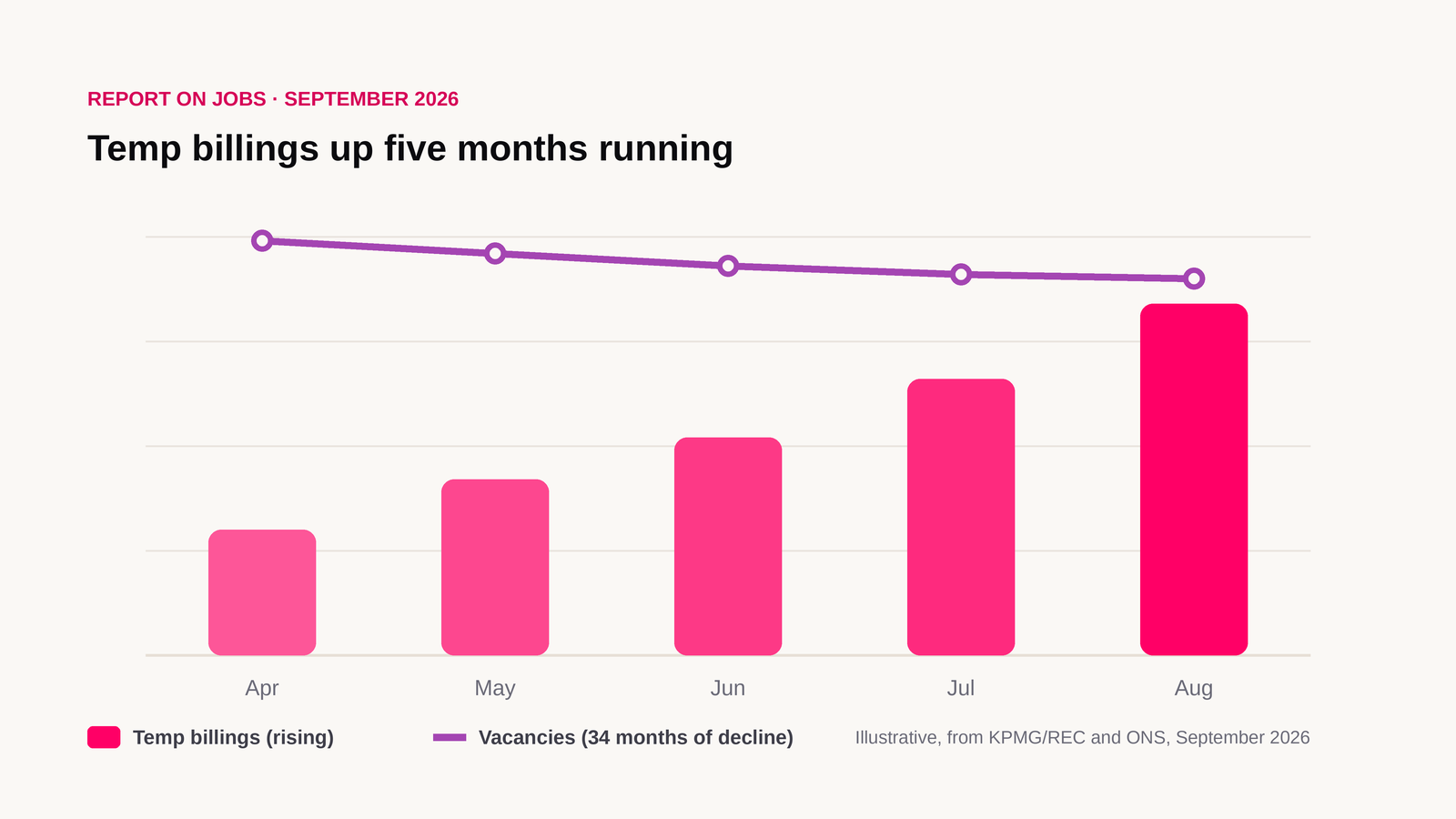
The KPMG and REC Report on Jobs for September, built from around 400 recruitment consultancies surveyed between 12 and 24 August, contains the line the industry has waited four years for: permanent placements rose for the first time since September 2022. It was marginal. The more important number for a contract agency sits underneath it.
What the data says
- Temp billings rose for the fifth month in a row, at the second-quickest pace in over three years, driven by "a preference for short-term staff and greater amounts of contract work".
- Temp pay rose at one of the strongest rates in two years, with starting salaries for permanent hires growing at the quickest rate since January.
- Vacancies fell for the thirty-fourth consecutive month, though the pace of decline was the second-weakest in nearly two years. Temp vacancies rose in Blue Collar and IT & Computing, and fell hardest in Hotel & Catering and Retail.
- Candidate availability rose at the sharpest rate in three months, with redundancies the most common explanation.
- Regionally, temp billings grew in three of the four English regions, led by the North; the Midlands was the exception.
The ONS labour market overview published on 15 September tells the same story from the other side. Vacancies stand at 702,000 for June to August, a level not seen outside the pandemic since 2014. Payrolled employees fell by 101,000 over the year to July. Unemployment is 4.9%. Regular pay is growing at 3.5%. And the ONS notes that feedback from its own vacancy survey "continues to suggest that smaller firms may not be recruiting because of increases in labour costs".
Read together: employers have capacity to add, but not the confidence or the budget to add permanently, so they are adding contract and temp instead. KPMG's Jon Holt called it employers favouring "flexible temporary hires to support their investment plans". That is the market a contract desk is built for.
Why growth is a cash problem
Here is the arithmetic nobody puts in a press release. Suppose the improvement lands on your desk as ten new contractors at £1,500 a week each. You pay them weekly: £15,000 out every Friday from week one. Your client, a large employer on 30-day terms who pays on the nose, settles the first invoice around week six. By then you have funded roughly £90,000 of contractor pay before a pound of margin comes back. On 60-day terms it is closer to £180,000. If the client is one of the ones paying on day 45 rather than day 30, add another £30,000.
Rising temp pay makes each of those numbers bigger. Rising candidate availability means you will fill roles faster, which is good, and which brings the cash requirement forward, which is the same thing looked at from the bank account. The agencies that struggled in 2021 and 2022 were not the ones that lacked demand. They were the ones whose funding limits, or whose funder's appetite, sat still while their book moved.
Four things to check before the growth arrives
- Know your client limits before you win the work, not after. If you are pitching a hirer whose exposure would double your ledger, ask your funder for the limit now, with the client's accounts and the likely volumes. We wrote about what to do when the answer is no here.
- Watch concentration as well as size. Growth that comes from one client is growth that one client can take away. Most facilities have a concentration rule and it usually bites at the moment you least expect it.
- Forecast by client and by consultant. Weekly gross, expected pay date, funding outstanding. If that sits in a spreadsheet you update monthly, it is not a forecast, it is a memory.
- Ask whether your funding scales without a re-platform. The worst time to change funder is the quarter your book doubles.
Where we come in
Raise funds 100% of the gross invoice from day one, so a new contractor is a decision about margin rather than a decision about cash. Client limits and concentration are managed on the platform with a named person on the other end of the phone, and the same platform carries an agency from Solo, where we fund the book, through Hybrid to Enterprise, where it borrows directly from one of our banking partners, without moving systems. If this autumn looks like the one where your contract desk finally gets its run, the sensible first step is to know what your book could fund before you need it to.
Sources
- KPMG and REC, UK Report on Jobs: September 2026, published 7 September 2026, compiled by S&P Global
- Labour market overview, UK: September 2026, Office for National Statistics, 15 September 2026