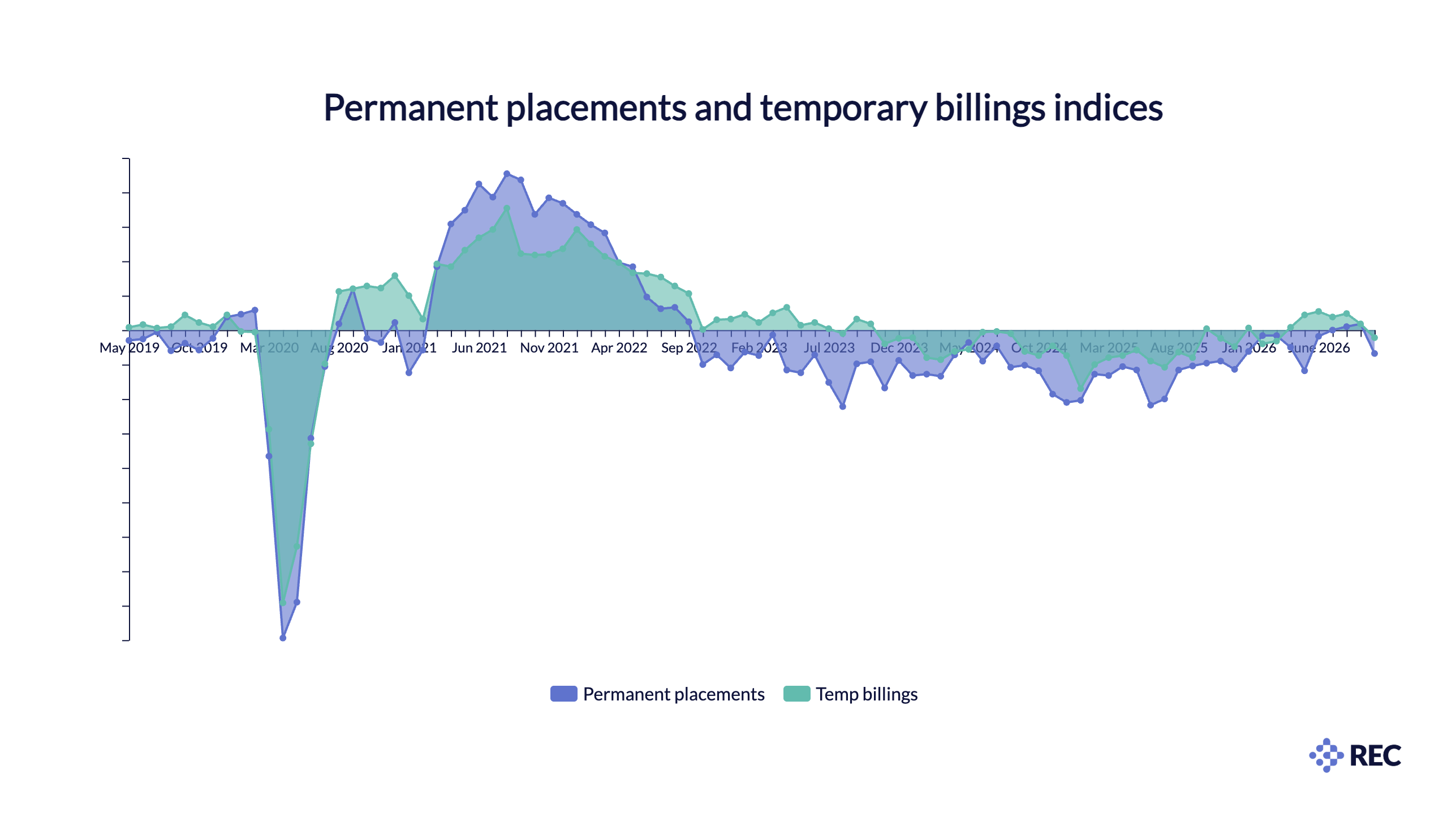
Five weeks ago we wrote that temp billings were rising for the fifth month running, and that growth is a cash problem. The KPMG and REC Report on Jobs published on 9 November tells the other half of the story.
What the data says
- Temp billings declined for the first time since March, which the REC describes as a renewed weakening in demand for temporary staff.
- Permanent placements fell for the first time in four months, with recruiters pointing to subdued business confidence and economic uncertainty.
- Candidate availability rose sharply, driven by redundancies and fewer job opportunities.
- Starting salaries and temp pay rose at a stronger pace, though both remain subdued by historical standards.
The REC's headline was that uncertainty and rising costs dampened recruitment in October. The survey period ran through the weeks before the 28 October Budget, when employers were waiting to see what it would cost them. The official figures point the same way: the ONS labour market overview for October put vacancies at 691,000 for July to September, down 37,000 on the year, with smaller firms still saying labour costs are the reason they are not recruiting. The next ONS release is on 17 November.
One soft month after six good ones is not a downturn. It is a reminder that the temp market moves faster than any other part of the labour market, in both directions.
What a flat or shrinking book does to cash
When a contract book grows, cash goes out before it comes in. When it shrinks, the reverse happens, and for a few weeks it feels like good news. Contractors finish, the weekly payroll falls immediately, and clients are still paying invoices from the busier weeks before. The bank balance improves just as the business gets smaller.
Three things then catch agencies out.
Minimum fees. Many invoice finance facilities carry a minimum monthly or annual service fee, set when the facility was sized for a bigger ledger. When volumes fall below it, you pay the minimum anyway, and the effective cost of funding each pound rises at exactly the moment margin is under pressure.
Availability shrinks with the ledger. A facility advances against outstanding invoices. Fewer new invoices means less to draw against, while fixed costs, salaries, rent and software, stay where they were. Agencies that used headroom in the facility to cover overheads feel this first.
Clients under pressure pay later. The same uncertainty that pauses hiring stretches payment runs. Rising candidate availability driven by redundancies is a signal about your clients' finances as much as about your candidate pool.
Four things to check now
- Find the minimum fee clause in your facility and compare it with what you would pay on current volumes.
- Track debtor days by client, weekly. A slipping average is usually one or two clients, and it is better to know which.
- Look at concentration. When a book contracts, the largest client becomes a bigger share of what is left, and concentration limits can bite on the way down as well as on the way up.
- Keep selling. More available candidates means faster fills when demand returns. The agencies that came out of 2023 strongest kept their client conversations going through the quiet months.
Where we come in
Raise prices funding per placement, so what you pay follows the work you are actually doing. Collections are run for you, with forecasting by client so you can see which payment terms are being honoured, and client credit limits sit in the placement flow so a weakening hirer shows up before the invoice does. If October has made you look again at what your facility costs in a quieter month, we are happy to run the comparison with you.
General information, not financial advice. Written on 12 November 2026.
Sources
- KPMG and REC, UK Report on Jobs, REC summary of the report published 9 November 2026, compiled by S&P Global
- Report on Jobs: Uncertainty and rising costs dampen staff recruitment in October, REC press release, 9 November 2026
- Labour market overview, UK: October 2026, Office for National Statistics, 20 October 2026